Context
Technical documentation is high-volume, deeply nested and sensitive to product version, configuration and terminology. A useful assistant cannot rely on a single nearest-neighbour search followed by a model call. It needs a retrieval system that produces sufficient, traceable evidence under real production constraints.
System architecture
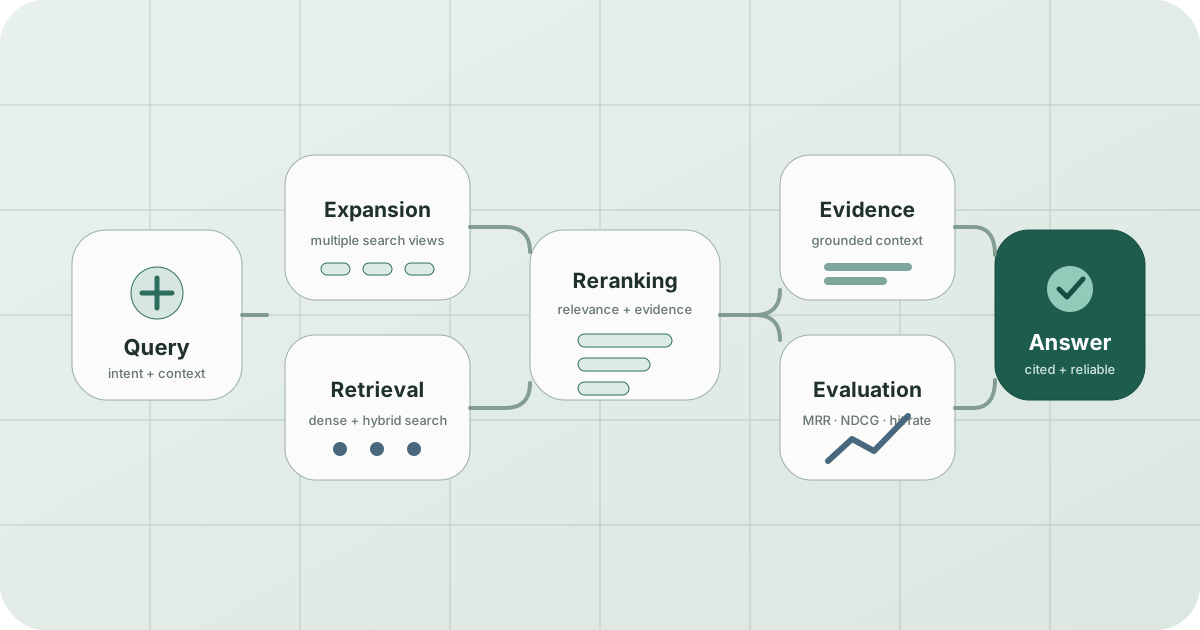
The retrieval path was designed as a sequence of independently measurable stages:
Document ingestion
I worked on ingestion paths that preserved document structure, stable identifiers and source URLs while processing headings, body text, tables, figures and code blocks. Incremental metadata comparisons allowed changed topics to be updated without rebuilding the complete vector collection.
Retrieval and reranking
The search flow combined dense embeddings, multiple expanded queries, candidate aggregation, deduplication and reranking. Retrieval thresholds and candidate counts were treated as tunable system parameters rather than fixed assumptions.
Reflective retrieval
A sufficiency check evaluated whether the retrieved context could support a complete answer. When evidence was weak, the workflow generated alternative search phrases and performed another retrieval pass instead of producing a premature response.
Evaluation
Retrieval quality was evaluated independently from answer style. This helps distinguish a search failure from a generation failure.
- MRR for the position of the first relevant result.
- NDCG for graded relevance across the ranked list.
- Hit rate for whether relevant evidence appeared within the retrieval window.
- Human relevance labels to build a reusable evaluation set.
- Golden-set regression to detect quality changes across model, prompt and retrieval updates.
Reliability engineering
Production quality also required citation validation, structured-output handling, retries, failure fallbacks, database migrations, observability and repeatability checks. These controls made model changes reviewable and reduced the risk of silent quality regressions.
What I learned
- Retrieval improvements are often more valuable than adding complexity to the final prompt.
- Evaluation datasets become product infrastructure: they should be versioned, reviewed and expanded from real failures.
- Source traceability must be designed into ingestion and retrieval—not added at the end.
- Model migrations need quality, latency, cost and reliability checks, not only syntax changes.